
It is fascinating to see what the mainstream media presents to the public as facts, versus the true story. Daniel Yergin got lots of press with his story in the WSJ supposedly debunking the peak oil theory. He is nothing but a shill for the ruling elite who want the American sheeple to stay calm as they are fleeced. His article is pure and utter bullshit. Kunstler ripped into it on Monday. But if you want a reasoned factual response to Yergin, you go to www.oilprice.com or www.theoildrum.com to get a thoughtful, non-ideologue assessment. Below are two seperate articles addressing Yergin’s article. Who do you believe? A paid oil industry whore or analysts who want to find the truth?
Submitted by John Daly of OilPrice.com
Daniel Yergin and Peak Oil – Prophet or Mere Historian?
On 17 September The Wall Street Journal published a fascinating article on “peak oil,” “There Will Be Oil,” written by Daniel Yergin, chairman of IHS Cambridge Energy Research Associates, an energy research and consulting firm and deserved recipient of Pulitzer Prize for his 1991 book, The Prize: The Epic Quest for Oil, Money and Power.
According to The Wall Street Journal, “There Will Be Oil” “is adapted from his new book, The Quest: Energy, Security and the Remaking of the Modern World.”
The essay will doubtless have widespread influence amongst prosperous The Wall Street Journal readers, but in his glib dismissal of “peak oil” theory advocates, Yergin glosses or ignores a number of issues fundamental to the larger picture, for whatever reason, and these oversights should be considered in any evaluation of the piece and the peak oil “specter.”
Yergin notes, “Just in the years 2007 to 2009, for every barrel of oil produced in the world, 1.6 barrels of new reserves were added.” But this fails to take into account the following points.
First is that for oil producing nations reserves are like money in the bank and inflated reserve figures are common. Even with the newest technology oil reserve figures remain at best “guesstimates” and should not be taken as hard and fast figures.
Secondly, while the Middle East for the foreseeable future will remain the world’s top producing area, it is unhappily also one of the most politically unstable regions of the world. The “Arab Spring’s” impact is still playing out, much less potential impact of Palestine’s incipient bid at the United Nation’s for recognition, both of which could yet still throw a major spanner in the works.
To recap briefly:
Saudi Arabia, the world’s first or second-largest producer, vying with the Russian Federation for top position, is not immune from either of the two aforementioned effects. Saudi Arabia does not allow foreign oil companies concessions and has adopted a strict conservation policy, so don’t expect to see a massive rise in production there anytime soon. As for Palestine’s impact, last week former head of Saudi Arabian intelligence and ex-ambassador to Washington, Prince Turki al-Faisal in an essay in the New York Times warned that an American veto of Palestinian U.N. membership would end the ”special relationship” between the two countries, and make the US ”toxic” in the Arab world.
As for Iraq, eight years after the U.S.-led invasion, holder of massive amounts of untapped reserves, the country remains mired in a low-grade civil war and unresolved political issues between its oil-rich northern Kurdish region and Baghdad. Further east, Iran is most unlikely to boost production significantly anytime soon because of U.S. sanctions imposed in 1979.
Libya remains the wild card, with only 25 percent of the country’s oil potential explored, but it has been wracked by six months of civil unrest, and the irredentist cadre of Gaddafi supporters could easily target the country’s oil infrastructure in the future.
In the Western Hemisphere, OPEC recently announced that Venezuela’s potential reserves could top those of Saudi Arabia, but the deteriorating relations between Caracas and Washington make an increase here unlikely anytime soon.
Many optimists pin their hopes on increased offshore production, from Brazil through Western Africa, the Mediterranean and the Caspian to the South China Sea but these regions’ output will suffer from the twin curses of both greatly increased “lifting costs” in the billions as well as political instability. West Africa is synonymous with corruption and civil war; Lebanon, the Republic of Cyprus, Israel and Turkey are sparring over eastern Mediterranean hydrocarbons; two decades after the collapse of the USSR Azerbaijan, Iran, Kazakhstan, the Russian Federation and Turkmenistan have yet to reach a definitive agreement on the division of the Caspian’s offshore waters and tension is rising markedly in the South China Sea, where China, the Philippines, Taiwan, Vietnam, Malaysia and Brunei are all pursuing contesting claims.
Of the aforementioned areas only Brazil has uncontested national sovereignty claims over its offshore deposits, and the government is sufficiently concerned about their security that it is considering building a nuclear submarine to patrol its offshore oil platforms. As for the rest, it is difficult to see how the nations involved will be able to attract large-scale investment into potential conflict zones.
Furthermore, quite aside from political wrangles, offshore drilling is both extremely expensive and comes with increased environmental risks.
Interestingly, the word “environment” appears only once in Yergin’s essay, in the sentence, “Environmental and climate policies can alter the timing and scale of development, as can geopolitics and politics within oil-producing countries.”
Given that the majority of the future’s oil production increase will come from offshore developments, the term should have been given greater prominence.
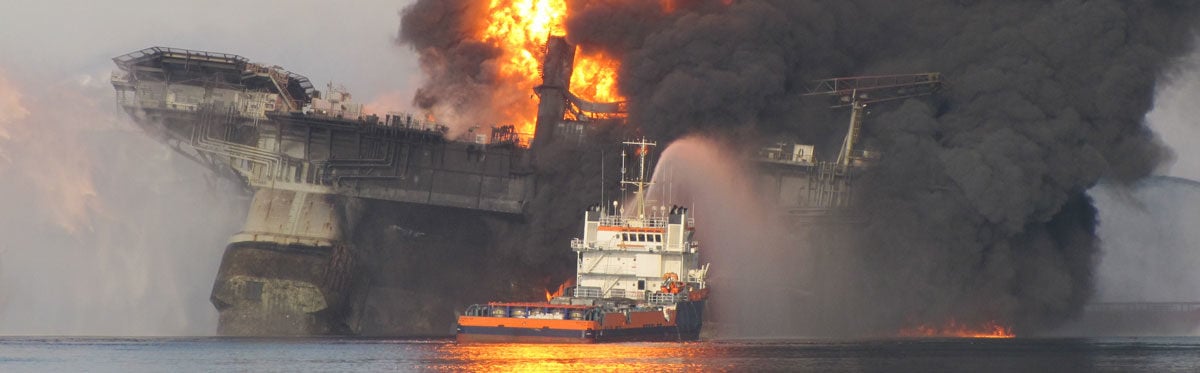
BP’s Deepwater Horizon Macondo oil spill in the Gulf of Mexico began on 20 April and spewed crude for three months in 2010 and was the largest accidental marine oil spill in the history of the petroleum industry, dwarfing the 1979 Gulf of Mexico Ixtoc I oil spill. Since the Deepwater Horizon incident unleashed 4.9 million barrels of oil the Gulf of Mexico suffered another rig explosion and fire at the Vermilion Block 380 A Platform on 2 September 2010.
Across the Atlantic, on 12 August a British subsidiary of Royal Dutch Shell announced a leak at a platform flow line in its Gannet field concession in the North Sea.
As for the BP leak, on 12 May 2010 California Democrat Representative Henry Waxman said that the House Oversight and Investigations subcommittee investigation into the Gulf oil spill revealed that the Deepwater Horizon Macaondo oil platform’s blowout preventer (BOP) did not pass a crucial pressure test just hours before the explosion.
Waxman said, “This catastrophe appears to have been caused by a calamitous series of equipment and operational failures. If the largest oil and oil services companies in the world had been more careful, 11 lives might have been saved and our coastlines protected.”
The Deepwater Horizon Study Group of University of California’s the Center for Catastrophic Risk concluded in its “Final Report on the Investigation of the Macondo Well Blowout,” released 1 March 2011, “At the time of the Macondo blowout, BP’s corporate culture remained one that was embedded in risk-taking and cost-cutting…”.
Tracking back the signs of incipient failure, on 28 February 2009 the Department of the Interior exempted BP’s Deepwater Horizon drilling operation from a detailed environmental impact study after concluding that a massive oil spill was unlikely.
Four months later, on 22 June 2009 BP engineers warned that the Deepwater Horizon BOP’s metal casing might collapse under high pressure. Seeking to spread the blame, in April 2011 BP sued Cameron International Corp., the maker of the failed Type TL 18¾in 15K double blowout preventer on the Macondo well, Deepwater Horizon drilling rig operator Transocean and Halliburton, the well’s cement contractor, saying they were largely to blame for the accident.
There are 3,800 active oil platforms in the Gulf of Mexico – how long until another major spill?
So, where does all this leave the world? Older producing fields and nations, such as Indonesia and Saudi Arabia’s massive Ghawar superfield have seen their production decline. Indonesia, which had begun producing oil in the early 20th century, saw its production slide so much that it left OPEC in 2008, seemingly confirming Marion King Hubbert’s “peak oil” theory.
While it is true that Hubbert’s predictions, made in the 1950s, took no account of future energy developments such as Africa, the Caspian and offshore, all of these regions and projects come with increased costs, which ultimately will undoubtedly be passed on to the consumers.
Is the world then running out of oil then? No, but the increase in future global oil production will likely be modestly incremental and production could be thrown off course by any number of possible events, from an Israeli attack on Iran to (another, but successful this time) al Qaida attack on Saudi Arabia’s Abqaiq oil refinery.
Accordingly, it is inexpensive oil that is in terminal decline, a development viewed positively by Yergin, who writes, “Activity goes up when prices go up; activity goes down when prices go down. Higher prices stimulate innovation and encourage people to figure out ingenious new ways to increase supply.”
Many American motorists would disagree.
Peak Oil – Now or Later? A Response to Daniel Yergin
Posted by Euan Mearns on September 21, 2011 – 7:20am
In a recent article called There Will Be Oil in the WSJ, Daniel Yergin once again attempts to debunk the concept of peak oil and sees global production capacity growing to 110 mmbpd by 2030, followed by slow decline. In this short report I will take a quick look at his key arguments in an effort to bring further convergence between the peak oil and business-as-usual camps.
Global oil production (crude + condensate + natural gas liquids: C+C+NGL) has been on an 82 million barrel per day plateau for 7 years despite record high oil price, deployment of technology such as horizontal wells and 3D seismic, the development of new oil provinces such as offshore Angola and unconventional play concepts such as the Bakken shale in North Dakota. Oil production rose during the great oil bear market from 1980 to 1998 but has largely stagnated during the great bull run ever since. Many things are upside down on the back side of Hubbert’s peak. Data from BP.
Decline rates
Any discussion about peak oil should begin with decline rates. Yergin’s organisation CERA is well aware of this fact having produced an excellent report on the subject a few years ago.
Decline is the natural process whereby production rates fall as a result of depressurisation of the reservoir combined with water ingress into the oil-bearing strata. Oil production companies go to great lengths to mitigate for decline by injecting water or gas to maintain pressure, well maintenance programs (work overs) and by drilling new wells. Observed declines are therefore much less than natural declines but nevertheless run at a globalised average of around 5% per annum.
With global C+C+NGL production running at 82 mmbpd, 5% observed net declines will wipe out 4.1 mmbpd capacity every year. What this means is that the oil industry must add 4.1 mmbpd new capacity every year from new field developments just to stand still. And this new capacity has to be derived from a stock of second-tier assets such as deep water Gulf of Mexico, heavy sour oil in Saudi Arabia, Arctic oil or the Bakken Shale since most of the favoured tier-one assets have already been produced.
In order for production to grow beyond the 82 mmbpd plateau the oil industry must add more than 4.1 mmbpd new capacity every year from an ever degrading pool of resources. To reach 110 mmbpd in 2030 would mean adding more than 4.1 mmbpd each year to 2030 reaching an additional 5.5 mmbpd new capacity in that year. Where is this new capacity going to come from? Yergin cites a list of new discoveries and new play concepts. But it has always been the case that new discoveries and plays have been developed and produced, and for the past 7 years these have been inadequate to provide new production in excess of declines.
New plays and play concepts
The oil industry continues to make new discoveries and to deploy new technology that has made it possible to develop low-quality reservoirs that would have been un-commercial a decade ago without new technology and high price. The giant Claire Field off the west coast of Scotland, and the Haradh segment of S Ghawar and the Khurais field, both in Saudi Arabia, are examples of low quality reservoirs, discovered decades ago, whose commercial development has been made possible by extended reach horizontal wells. Developing these giant fields in this way has enabled the global industry to maintain the 82 mmbpd plateau but not to exceed it.
Yergin cites new discoveries off shore in Ghana, Brazil and French Guiana as examples of new plays that may boost future production together with unconventional oil from Canadian tar sands and oil produced from shales like the Bakken. New production in Angola, Rajasthan in India, Congo Brazaville, and deep water GOM may be added to the list of recent new provinces that have been brought on stream. The fact is that without this steady stream of new developments, the oil industry will fail to maintain production at current levels and production will enter the decline phase.
UK independent explorer Cairn Energy has just drilled 6 dry wells in the Arctic waters off the West coast of Greenland, reminding all that despite the best seismic technology and basin models, exploration remains a high risk business.
The Bakken Shale in North Dakota does represent an interesting case study.
In 2003, the Bakken formation in North Dakota was producing a mere 10,000 barrels a day. Today, it is over 400,000 barrels, and North Dakota has become the fourth-largest oil-producing state in the country. Such “tight” oil could add as much as two million barrels a day to U.S. oil production after 2020—something that would not have been in any forecast five years ago.
In email correspondence, Oil Drum editor Arthur Berman pointed out that Bakken production comes from around 6000 wells, giving an average rate of about 67 bpd per well whilst Oil Drum editor Tad Patzec pointed out that in the GOM total, Bakken production may come from a handful of Macondo-type wells. Thus, while there is an interesting lesson for all to learn from the Bakken, the scale of effort required to win this production is immense and despite this effort, global oil production remains glued to its 82 mmbpd plateau.
Similarly, the immense effort to develop the Canadian tar sands has not managed to boost global production for the last 7 years. If this scale of effort made in the tar sands and the Bakken are not maintained then global oil production will fall.
Oil price and technology
Hubbert insisted that price didn’t matter. Economics—the forces of supply and demand—were, he maintained, irrelevant to the finite physical cache of oil in the earth. But why would price—with all the messages that it sends to people about allocating resources and developing new technologies—apply in so many other realms but not in oil and gas production? Activity goes up when prices go up; activity goes down when prices go down. Higher prices stimulate innovation and encourage people to figure out ingenious new ways to increase supply.
I certainly agree with Yergin that the simplistic geological maximum flow rate model advocated by early workers such as Hubbert needs to be refined to incorporate a systems approach based on economics, society, politics and technology. It is of course the case that high price will stimulate oil industry activity whilst at the same time reducing demand. The key question here is where does the price balance lie between stimulating production and killing demand?
Yergin fails to mention that we have experienced a high price environment for several years now and this has failed to boost production beyond the 82 mmbpd plateau (see chart up top), in part because high price has at the same time tempered demand for oil, especially in the OECD. High price does not seem to have impacted the decline of the North Sea at all, although it seems likely that without high price that decline would have been even more rapid. Ingenious technologies have helped maintain this plateau but it is far from clear that they will in future move oil production substantially above it.
5 trillion barrels more
Currently, it is thought that there are at least five trillion barrels of petroleum resources in the ground, of which 1.4 trillion are deemed technically and economically accessible enough to count as reserves (proved and probable).
There is simply no point speculating about vast unconventional oil resources replacing the easy flows of light sweet crude upon which our current society and economy is based. The cost of recovery, in economic, energy and environmental terms is quite simply too high. And as already noted for unconventional oil sources like the Bakken and Canadian tar sands the scale of endeavour required is immense compared with traditional oil that flows out of the ground at rates of tens of thousands of barrels per day. The type of society that may be founded on unconventional sources such as these will look very different to today’s society that is founded on easy flows of cheap oil.
A parable on Scottish unconventional diamond resources may help illustrate this point. Diamonds occur in Earth’s upper mantle, at depths greater than 100 kms, below crust of Archaean age (older than 2.5 billion years old). Scotland is blessed to have rocks of this age in the northwest highlands of our small country providing us with potentially millions of tonnes of diamond resources. All we need to do is to wait for prices to rise and the right technology to come along that will enable us to mine at such great depths and we will single handedly flood the market (dumping prices – oops) ending diamond scarcity once and for all.
Peak demand
In this view, the world has decades of further growth in production before flattening out into a plateau—perhaps sometime around midcentury—at which time a more gradual decline will begin. And that decline may well come not from a scarcity of resources but from greater efficiency, which will slacken global demand.
The concept of peak demand is actually one that I subscribe to but certainly not in the way articulated here by Yergin, who seems to believe that improved energy efficiency will lead to a reduction in demand for oil. In fact, the exact opposite of this is more likely to be true where improved energy efficiency enables society to afford a higher price that will lead directly to more, not less oil being produced.
The notion of peak demand that I subscribe to is one where there is a maximum price for oil that the global economy / society can bear. That price will fix the amount of poor quality resources that can be converted to reserves since every time the price ceiling is hit the World gets cast into recession reducing demand for oil in a way just experienced during the 2008 / 09 peak oil crash.
Summary and conclusions…
Over the years there has been significant convergence between the peak oil and business-as-usual camps, each hopefully learning from the other. Yergin, whilst attempting to debunk peak oil, appears to have been converted to a late peakist. I can certainly relate to many of the concepts described by Yergin – price influencing supply and demand, technology, innovation and new plays etc – but wonder when these are going to result in new production capacity (supply) that exceeds annual declines?
The stakes are high. Should policy makers listen to Pulitzer Prize winning historians? Or should they listen to geologists and a growing band of economists who can see the dependency of economic growth upon increasing supplies of cheap energy that quite simply do not appear to exist? Most important of all, will the WSJ publish a modified view of the oil world than that presented by Daniel Yergin?


Administrator says:
Daniel Yergin Op-Ed on July 31, 2005:
Prices around $60 a barrel, driven by high demand growth, are fueling the fear of imminent shortage — that the world is going to begin running out of oil in five or 10 years. This shortage, it is argued, will be amplified by the substantial and growing demand from two giants: China and India.
Yet this fear is not borne out by the fundamentals of supply. Our new, field-by-field analysis of production capacity, led by my colleagues Peter Jackson and Robert Esser, is quite at odds with the current view and leads to a strikingly different conclusion: There will be a large, unprecedented buildup of oil supply in the next few years. Between 2004 and 2010, capacity to produce oil (not actual production) could grow by 16 million barrels a day — from 85 million barrels per day to 101 million barrels a day — a 20 percent increase. Such growth over the next few years would relieve the current pressure on supply and demand.
Like or Dislike:
1
0
21st September 2011 at 2:23 pm
Administrator says:
In a November, 2004 interview in Forbes, Mr. Yergin asserted that oil prices would be back to a long term price ceiling of $38 by late 2005–because of a steady increase in global crude oil production. It turned out that Mr. Yergin’s predicted price ceiling has so far been the price floor. The lowest monthly spot crude oil price that the EIA shows for post-November, 2004 is $39.
I suspect that just as Mr. Yergin was perfectly wrong about oil prices, he may be confidently calling for decades of rising production, just as we come off the current production plateau and just as an accelerating decline in Global Net Exports kicks in.
Like or Dislike:
1
1
21st September 2011 at 2:23 pm
Persnickety says:
Discussing Yergin’s propaganda is like discussing whether the Federal Reserve has the best interests of the US middle class at heart.
Like or Dislike:
5
2
21st September 2011 at 2:29 pm
Persnickety says:
Yergin is a cock
Like or Dislike:
2
3
21st September 2011 at 5:08 pm
Smokey says:
Persnickety,
I think that if you were to give Yergin a jump, he may come around to your point a view. I think you and he would make a fine couple.
Like or Dislike:
2
2
21st September 2011 at 5:15 pm
Smokey says:
Seriously, Persnickety.
I’m not gay, but I know a couple of twinkies who write for Forbes. They say that Yergin is well endowed. Rumor has it, he has quite a package. You and he could get persnickety together. Maybe start something long term together, you know, maybe move in together.
Give it some thought, Snick.
Like or Dislike:
4
1
21st September 2011 at 5:47 pm
Persnickety says:
SEYC
Like or Dislike:
0
0
21st September 2011 at 6:19 pm
ron says:
Why worry, president Obama has the problem licked with his job elimination plan to lessen the demand for oil.
Like or Dislike:
3
0
21st September 2011 at 7:11 pm
scott says:
Decades ago, it might have been around the time of Yom Kippur 1973 Arab/Israeli war, Yergin first came to my attention with an article in ‘Foreign Affairs’, the light reading I used to indulge myself with as a college dropout. As I recall, he was an oil ‘hawk’ then pounding the drum for ever escalating oil prices.
He was proved wrong then and oil fell to $10 or so levels during the 1980′s. I guess he learned back then that prognisticating energy prices is a fools game and that even Harvard academics stink and shine like rotten mackeral in the moonlight when it comes to predicting the future.
That said, I do believe oil prices are likely to stay at a $100 to 150 barrels for the immediate future. I doubt they will blow beyond that because the effect would be so dire as to cause those nations with the ability to engage in some serious ‘demand destruction’ upon those nations unable to resist. Oil is serious stuff. When the US embargoed Japan in 1941 the Japanese Navy set sail for Pearl Harbor. Hitler sent his panzers into Russia to get the stuff. Everyone knows this. Those who have it can either sell it at a prices the market can bear or see how their military can stand up to ours.
Well-loved. Like or Dislike:
6
1
21st September 2011 at 8:34 pm
Colma Rising says:
Scott:
Take me to the Olympic Club… I promise not to wear Ben Davis and combat boots, I’ll dust off a cheap suit (sorry, but my dress shoes are combat boots). I can be like a novelty for that old oil money hobnobbin’ up there… They can say ” Oh how cute, one of those people!!!” and make jokes like “You want some really good whiskey… like Gentleman Jack (rim shot)!” I also promise not to soil the ladies.
Not kidding man, I need some connects for some letters of recommendation… sorry I bagged you for the invite last month.
Like or Dislike:
3
0
21st September 2011 at 8:56 pm
Colma Rising says:
Colma Rising: ‘hoin for the big time…
Like or Dislike:
2
0
21st September 2011 at 8:57 pm
AWD says:
Colma:
Too bad you don’t live near here. I could take you to the “Mud Club”. Rednecks who drive their jacked up trucks through a massive mud bog. Then some dive in, or belly flop. Sounds like right up your alley. You could also get a letter of rec. from a doctor. Those go over well for some reason. Or you could come over, and we could sit out on the porch and smoke a Cuban Montecristo “A” until you got sick and pucked. You could bring the Jack, and the babes. Just jump on your private jet (or steal or highjack one). Sounds like fun, eh?
Well-loved. Like or Dislike:
6
0
21st September 2011 at 9:05 pm
Colma Rising says:
I can’t golf well, but I can dig…
Isn’t it freezing up there, doc?
Like or Dislike:
3
0
21st September 2011 at 9:17 pm
AWD says:
I live at a lower latitude than you lunkhead, tip of S. Illinois. Dangerously close to Kentucky, if you know what I mean. It was 85 today.
Like or Dislike:
4
0
21st September 2011 at 9:34 pm
matt says:
Colma,
At least people don’t refer to you as Santorum.
http://www.cnn.com/2011/09/21/tech/web/santorum-google-ranking/index.html?&hpt=hp_c2
Like or Dislike:
4
0
21st September 2011 at 9:46 pm
Colma Rising says:
Matt: No, just “Dunce”, “Asshole”…
AWD: It’s 60-something right now. December? 50-something degrees… Actually the Indian Summer’s trying hard to poke through the fog… It might have been 70 earlier! Fucking miserable! (The girls take off the hoodies and uggs though…)
Like or Dislike:
4
0
21st September 2011 at 9:51 pm
AWD says:
1. santorum
The sometimes frothy, usually slimy, amalgam of lubricant, stray fecal matter, and ejaculate that leaks out of the receiving partner’s anus after a session of anal intercourse. Named, by popular demand and usage, after legislator Rick Santorum because of his homophobic political statements.
Rick Santorum’s Anal Sex Problem
http://motherjones.com/politics/2010/08/rick-santorum-google-problem-dan-savage
Like or Dislike:
3
0
21st September 2011 at 9:53 pm
Colma Rising says:
Gotta watch out, the poor chicks at school are freezing. I’m wearing eye protection…
Well-loved. Like or Dislike:
5
0
21st September 2011 at 9:53 pm
AWD says:
Mr. Rising:
Those are called “headlights” were I come from…
Like or Dislike:
5
2
21st September 2011 at 9:58 pm
AWD says:
My God, PM TBP has sure gotten BORING….
Are my toes still there?
Well-loved. Like or Dislike:
8
2
21st September 2011 at 10:30 pm
Colma Rising says:
AWD:
Traffic on tbp, at least any posters, dries up after 9 Eastern and weekends…
RE used to bring it late.
Like or Dislike:
3
0
21st September 2011 at 1:07 am